

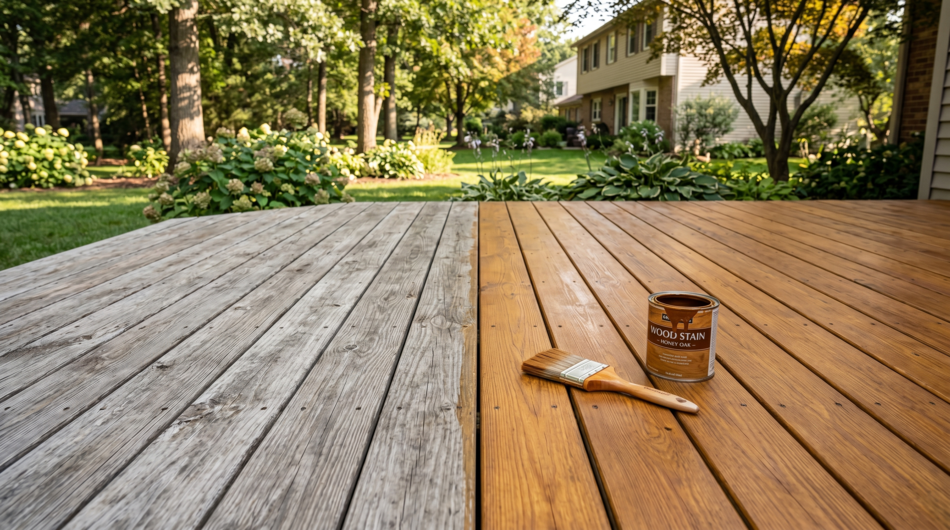
If you have spent any time trying to figure out how to protect your outdoor deck, you have probably run into the same question: deck staining vs deck sealing — what is actually the difference, and which one is right for your situation? The two terms get used interchangeably all the time, but they are not the same product, they do not do the same job, and choosing the wrong one can leave your wood either unprotected or looking worse than before. Understanding what each option does is the first step toward making a decision that actually holds up through the seasons.
What Deck Sealing Does — and When It Makes Sense
A deck sealer is primarily a protective product. Its job is to create a barrier on the surface of the wood that repels water, slows the absorption of moisture, and reduces the cracking and warping that comes from repeated cycles of wet and dry conditions. Sealers are typically clear or very lightly tinted, which means they preserve the natural appearance of the wood without adding visible color.
If your deck is made from a premium wood species that already looks the way you want it to look, and your main concern is keeping moisture from degrading the structure over time, a sealer is a sensible choice. It is also worth considering for newer decks where the wood grain and tone are still in good condition and you simply want to maintain what is already there. The trade-off is that sealers offer limited protection against UV damage, which means prolonged sun exposure will gradually gray and fade the wood even with regular applications.
What Deck Staining Actually Adds to the Equation
Deck staining goes a step further than sealing in one important way: it adds pigment. That pigment is not just cosmetic. The color in a quality deck stain contains UV-blocking compounds that protect the wood from sun damage, which is one of the primary forces behind fading, graying, and surface deterioration. When you choose deck staining, you get moisture protection and UV resistance in the same application, which makes it a more complete solution for most outdoor wood surfaces.
Stains come in a range of opacities, from semi-transparent options that let the wood grain show through, to solid stains that cover the surface almost like a paint. Semi-transparent stains are popular because they balance protection with a natural look. Solid stains are worth considering when the wood has already shown significant weathering or discoloration and you want a fresh, uniform appearance rather than highlighting the existing texture.
For homeowners in Massachusetts and across New England, where decks face intense summer sun followed by harsh winters, the combined protection that deck staining offers is usually the better long-term investment.
How to Know Which One Your Deck Actually Needs Right Now
The condition of your wood matters more than most people realize when making this decision. If your deck is relatively new, the wood is in good structural shape, and you are not dealing with visible graying or UV damage, a sealer may be all you need for this cycle. Run a simple water test: sprinkle a small amount of water on the surface and watch what happens. If the water beads up and rolls off, the existing finish still has life in it. If the water soaks in quickly, the wood is unprotected and needs attention soon.
If the surface is already showing gray tones, surface cracks, or uneven fading from sun exposure, deck staining is the more appropriate choice. Trying to seal a deck that has significant weathering without addressing the surface first will lock in the damage rather than reverse it. In those cases, proper preparation — cleaning the wood and opening up the grain — is just as important as the product you choose to apply.
One rule that applies to both options: the timing matters. In New England, the window for exterior wood work is roughly late spring through early fall, when temperatures are stable and rain is not imminent. Applying either a stain or a sealer in marginal conditions leads to poor adhesion and dramatically shorter results.
How Often Should You Be Treating Your Deck?
This is one of the most common questions homeowners ask, and the honest answer is that it depends on the product, the wood, and how much weather exposure the deck gets. As a general guideline, most decks benefit from professional attention every three to four years. A deck that faces direct sun for most of the day, or one that collects standing water after rain, may need treatment closer to every two to three years.
Waiting too long between treatments is where most of the real damage happens. Once moisture works its way into unprotected wood and begins the cycle of swelling, contracting, and cracking, the scope of the repair grows quickly. What could have been a straightforward staining job becomes a more involved project involving sanding, repairs, and multiple coats to restore the surface.
The deck staining vs deck sealing question does not have a single right answer for everyone, but it does have a right answer for your specific deck, based on its age, condition, and what kind of protection it still needs. If you are not sure where your wood stands, or if it has been a few years since it was last treated, the team at New England Home Repairs can take a look and give you a straightforward assessment. Get in touch today and protect your investment before the next season does more damage than it should.